The next morning we had breakfast with the already familiar company. By the way, the Canadian girl told us she had been a trapper for a few years, meaning a fur hunter, I don't know if it was a hobby or a profession.
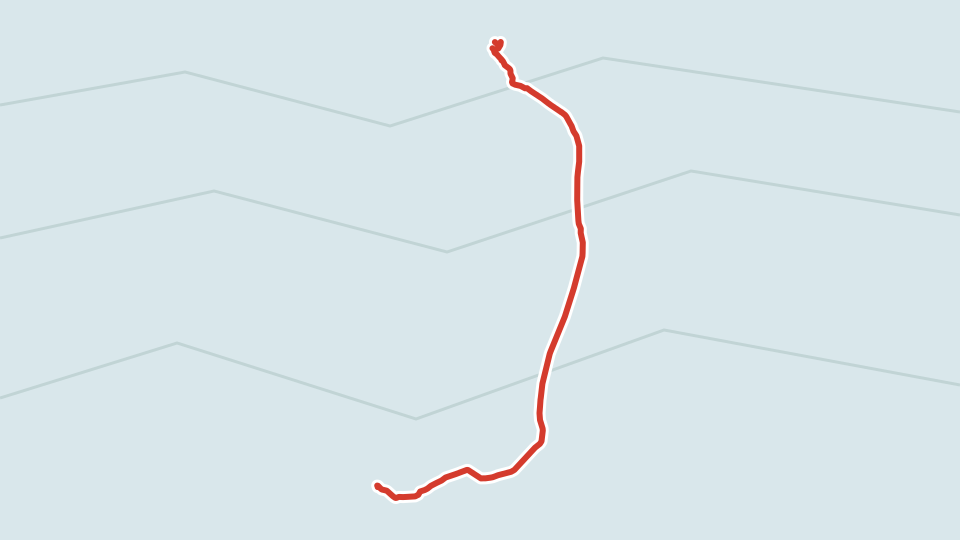
Dana is a large nature reserve, and there is a multi-day trekking route going down the gorge through it. If I had the time and health, I would have set off without a second thought, but alas, all we could afford was a little walk around. The host and the Europeans explained to us how to do a small loop around the village, and we hit the road. I must say that for this day we had prudently planned a very easy bike section — we just had to roll down to Shobak Castle. Unfortunately, an error crept into the plan, one of the few in our planning. The thing is, I had laid out the track for the fifth day not from the hotel, but literally half a kilometer to the east. As you may remember, yesterday, over this exact half-kilometer (as the crow flies), we descended three hundred meters, and those meters were eagerly waiting for us today.
However, I'm getting ahead of myself — for now, we set off hiking along the water conduit, and our goal was the spring. I must say that after yesterday's overexertion I was feeling pretty crappy, and with disgust imagined how I would ride further, but there was no getting around it.

On the way we saw some olive and pomegranate trees, a donkey in a stone shed, and at the end a huge flock of sheep with a shepherd and herding dogs.

The pomegranates, unfortunately, were already overripe


Cool plants growing right on the rocks

The landscapes in Dana turned out to be magical and fairy-tale-like; the gorge disappearing into the distance was very inviting


The Jordanian flag looks festive

The sheep deftly jump over the rocks, rarely does one hesitate for half a second before dropping down


When we returned to the room, I couldn't take it anymore and lay on the bed for fifteen minutes. Oddly enough, I felt a good deal better.
We drank a little more tea for the road, since they were treating us, paid up, and said goodbye to the host. Unfortunately, I kept forgetting to write down the names of the people we met, which would have added some color to the story. I can only roughly tell you what guys are usually called here: Ali, Ahmed, Salman, Suleiman. It fully fits the stereotypes!
Hotels, by the way, cost around 25-40 dinars per night (for a double room), and the quality of the hotel weakly correlated with the price, with the exact exception of the night we had ahead of us today.

So, we clambered up for an hour or two to our rallying point, enjoying the stunning views of the Dana gorge and the gale-force wind. We were later told that such winds aren't uncommon here; they pop up suddenly, drag on for a few days, or sometimes a couple of weeks, and then suddenly die down. When I was preparing for the trip, I knew about this hurdle, but I rather expected winds on the shores of the Dead Sea, I had fewer worries about the mountains. More's the pity — when the wind reaches its maximum strength, it's not only cold, but also very hard to walk, especially uphill. Riding is downright impossible. We had already gone through all this in Iceland with Andrey, and it looked like a second round was coming up. Fortunately, today only a drop in elevation awaited us, so the wind shouldn't have been that much of an obstacle.

In the light of day, the village didn't turn out to be that small, but from the hotel host's story it follows that many of the houses, if not all of them, are abandoned


A rider was prancing around, showing off in front of us

Mountains elevate


It didn't take too long, and we were at the top. From there the road was only downhill, and it seemed to us that it would be simple and pleasant. However, the winds of Jordan had their own opinion — sometimes, even though we were riding almost constantly downhill, we had to pedal like grown-ups. The landscapes, however, were getting more and more beautiful.


It's immediately obvious which way the wind blows


Soon enough we reached a small town near the crusader castle of Shobak. We took a shortcut to the hotel, and although we had to pedal uphill a bit, the hotel was located very well, not far from either the town or the castle. From the track it seemed that the hotel was very close to the castle, and we would have to gain more elevation, but in reality a brown signpost led to the hotel, just like the ones we have for tourist attractions. Why such an honor for a hotel? – we wondered.
As it turned out, the "Montreal" hotel, meaning "Royal Mountain" (that's what the Crusaders sometimes called Shobak), was the fanciest one we'd seen so far: at the entrance — a metal detector frame, naturally unused by anyone, the lobby is richly decorated, the rooms have no lopsided wardrobes, but on the contrary, there's a view with a balcony right overlooking Shobak Castle. The hotel building is neat, but the staff's English still sucks. Not a single car in the parking lot: a whole luxurious hotel just for us!
The Montreal, however, didn't escape the two great problems of Jordanian havens for wanderers. To defeat the electrical outlet, I had to stick a zip tie into it, otherwise the plug wouldn't go in. And even in such a huge, beautiful hotel, where we were practically the only guests, and so I decided to pamper myself a bit longer, when Sasha went to take a shower, the hot water abruptly died down. I think it's karma for him killing innocent little animals.
But in the shower, by Jordanian standards, a real miracle was discovered — the shower was separated from the toilet by a glass wall, even if only a half-wall. Usually there are no curtains at all, and the water from a century-old showerhead floods everything around, the walls, the floor, and what's especially spicy — the toilet and the toilet paper, which they try to mount in such a way that as much water as possible gets on it.


We arrived at the hotel by three, and we still had a couple of hours before sunset to visit the castle itself. As always happens, the lazy body and mind were by no means eager for another two hundred meters of climbing, even without the bags, but we wouldn't be ourselves if we didn't know how to overcome such impulses. Rybakov again voiced the opinion that the castle would be boring, but this time somewhat uncertainly, because this castle looked impressive even from the outside. Oddly enough, we didn't take any photos from the outside.
Taking our flashlights and some warm clothes (the day was noticeably colder than the previous ones, and after sunset we expected an icy breeze), we moved to the neighboring mountain where the castle was located, and half an hour later we were already there. As usual, when we were riding up on our bikes, people practically applauded us: this time it was tourists who had to walk up from the parking lot to the entrance of the ruins. For them, even that was a heavy physical exercise, judging by their admiration of the fact that we simply rode our bikes up the hill. Without bags, it's not even an achievement, because the bicycle is not only lighter, but also handles much better, since its rear end doesn't swing back and forth from inertia.
At the entrance to the castle, like a computer role-playing game character who is permanently stationed there at any time of day or night, a souvenir seller was set up with his simple belongings; he amiably offered to keep an eye on our bikes, since he was hanging around there anyway.
Already used to the fact that you can do this here and nothing will happen to you, we agreed and set off to explore the majestic ruins.